An Introduction to Learner Lifetime Value
What exactly is learner lifetime value? It’s not a concept that you hear about in higher education. It turns out the concept you do hear about - lifelong learning - isn’t particularly well-defined either. Lifelong learning is having a resurgence in higher ed, so we ought to be clear about what it means. I don’t think the way higher education has traditionally defined lifelong learning is going to get us very far in this resurgence. Lifelong learning can’t just mean serving people of different ages. It isn’t different types of credentials. Lifelong learning isn’t defined by a learner’s motivation, nor by the mode of delivery. It shouldn’t be considered everything outside the “core” of the institution. Lifelong learning is among the oldest work we do in higher education. We need a new concept for thinking about the relationship between a learner and an institution today.
Defining Learner Lifetime Value
That concept, I contend, is learner lifetime value. Here’s how I define it.
Learner lifetime value is the act of intentionally designing your institution to be the place a learner returns to, again and again, across their lifetime.
That’s a little long, but then again, so is the relationship.
Learner Lifetime Value as Connective Tissue
Because learner lifetime value sounds like a metric, I find that an analogy helps explain what it really is. This particular analogy is also my favorite because it breaks the default search for new programs or new audiences. Learner lifetime value is like the connective tissue in the higher education “body.” In other words, it serves the same purpose in a college or university that connective tissue serves in the human body. Picture the human body: hundreds of specialized parts, each doing something different. The connective tissue is important because it gets those parts to act as a whole. It does the critical, underappreciated work of binding, supporting, protecting, organizing, and connecting them. Without that connective work, the body can’t perform the functions we tend to think of as the important ones. It’s that connectivity that allows us to see one whole body instead of a collection of individual parts.

Think, for example, of a baby standing up for the first time. The baby wobbles as she lifts herself up by the edge of the couch. Then the wobble steadies, and a second later, she’s standing up. She shrieks with delight! You turn and gleam with pride: “Her legs finally got strong enough.” But her legs didn’t really get stronger, at least not just the leg muscles you’re thinking of. Sure, her legs supplied the effort, but what converted that effort was the tissue you couldn’t see. The muscles created the momentum, but the tendons picked it up and passed it to the bones. Even connective tissue away from the legs, like in the knees and hips, held the whole structure together. Because of the connective tissue, none of the parts were working in isolation. Remove that connective layer and even the strongest muscles couldn’t bring a baby to stand. They did the critical, underappreciated work of lifting the baby’s entire body.
Creating a Coherent Whole
Defining a university’s lifelong learning position conveys a lot about the role it intends to play across a learner’s lifetime. It shapes a powerful whole-institution strategy for whose lifelong learning needs the institution will serve, what role it will play in meeting them, what it will connect to create value, and what learners should be able to count on from it over time. If I told you a university saw its job as graduating students, you would have a very different set of expectations than if it saw its role as being a lifelong learning partner. We expect a university focused on graduating students to provide excellent advising, offer the courses students need when they need them, and track progress toward the degree. Our expectations for a lifelong learning partner are different. We expect it to remember what we have already learned, recognize when our needs change, guide us toward what’s next, etc.
Ditch the Personas
Understanding who your learners are matters, but a static view of a learner is a poor foundation for designing a lifelong relationship. Lifelong learning requires us to understand how that learner will change over time. In higher education, one of the first tools leaders and consultants reach for when trying to understand learners is the persona. If you aren’t familiar with personas, think of the old dating section of the classifieds: a handful of traits meant to tell you who this person is. They usually include things like age, goals, motivations, behaviors, etc. Typically, it looks like this:
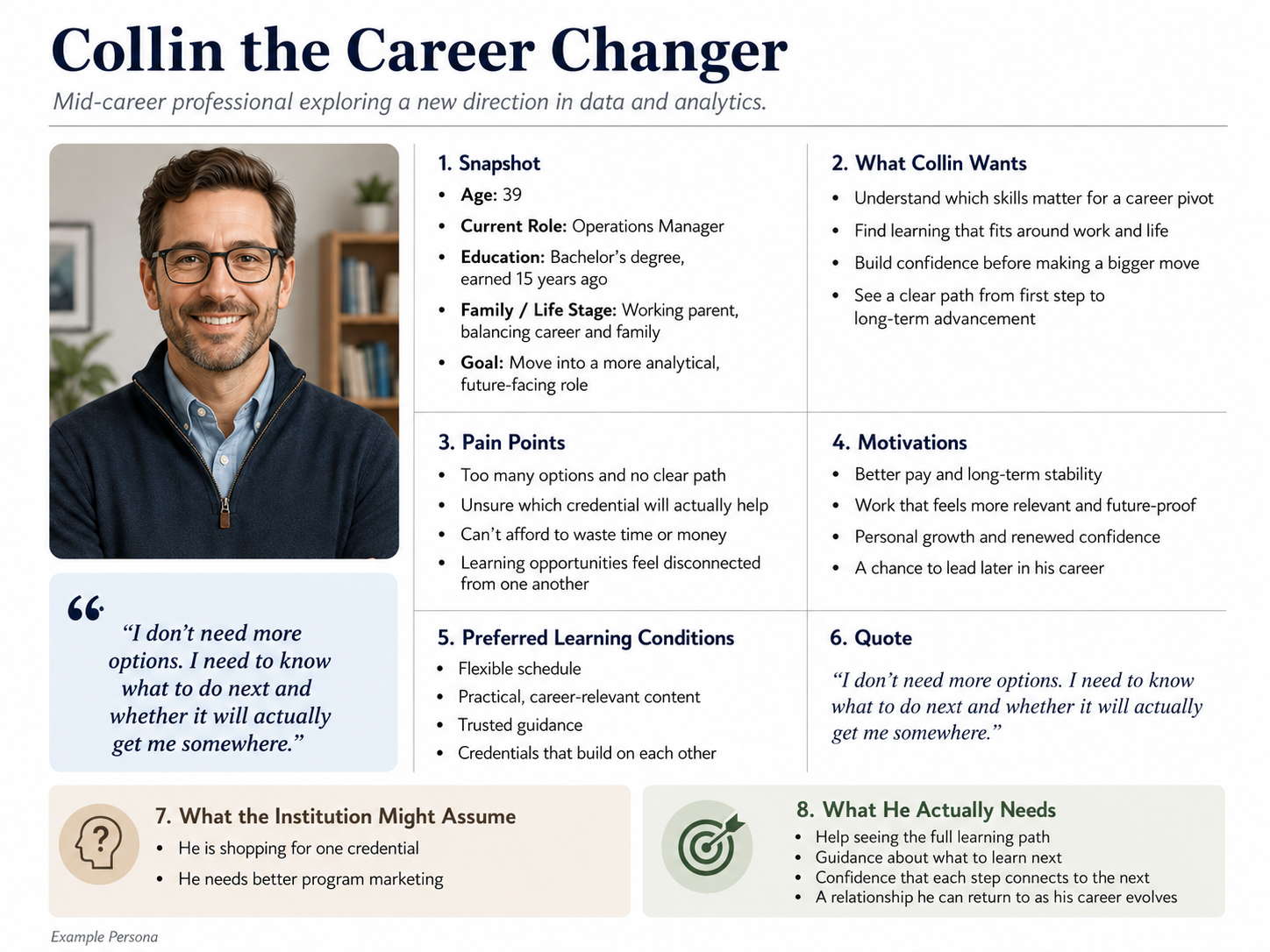
No offense to all of my friends in marketing, but I could probably write an entire book about why I think this practice is not only misleading but potentially biased. For now, I’ll offer this: Personas ask us to reduce a learner to a set of characteristics at a single point in time. You capture them in a five-year window of a “100-year life.” Personas are fundamentally incompatible with the pace of change in learners’ lives. A static picture cannot help an institution design for a relationship that may last decades.
The 5 Components of a Learner Lifetime Strategy
The only useful lesson from personas is that institutions need a disciplined way to serve the actual needs of learners today. These are the decisions college and university leaders need to make to determine how their institution will create and deliver learner lifetime value.
Define the learningspan
Determine the institutional role
Build the connective tissue
Identify the priority audiences
Define the lifelong learning position
You can maximize learner lifetime value when you have defined each of these components in the best way possible for your institution.
New programs, new audiences, marketing campaigns, and pricing models are all examples of things that should come after you have defined your learner lifetime value strategy.
Simply stated, learner lifetime value defines how an institution will maximize the value it gives to, and gets from, learners over time.